Voltage-sensitive relay: I tried it so you don't have to#
Sat 02 Aug 2025 02:46:55 PM UTC
In 2001, "auxillary power" was not a concern of the manufacturers of
sportsbikes - even otherwise practical sportsbikes like the CBR600F.
It doesn't come with any handy USB or 12V sockets or even spare
fuseholders under the seat.
In 2025 I've resisted bedecking it with a million current draws, but I
do need power for the USB connector that my phone
is connected to, and for the wired-in dashcams, and I thought I'd try
and be clever.
The idea was a good one. As eny fule kno, a car/bike battery puts out
around 12V and an alternator provides 14V, so if you have accessories
that you want to work only when the engine's running and you're not at
risk of draining the motorbike battery, you could install a
voltage-sensitive relay so that they're only powered when the supply
voltage exceeds, say, 13V. Therefore:
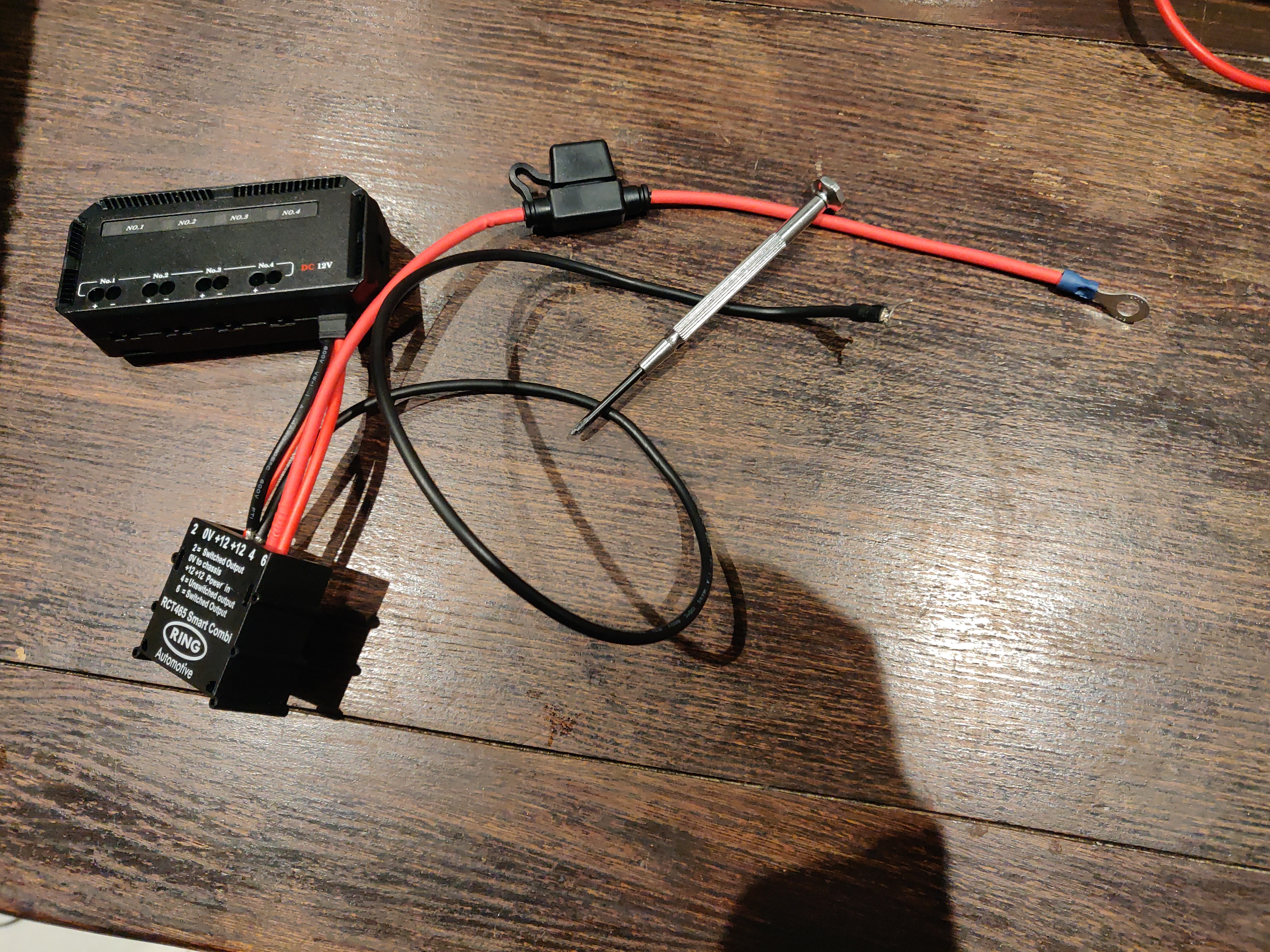
-
an Aliexpress clone of the Oxford accessory fuse box, this has 4 5A
fused connections through relays, and turns them on when it sees a
voltage on the thin red wire that you're supposed to wire to a
switched live
-
but instead of finding a relatively exposed accessory 12v supply
somewhere in the loom and tapping it, I connected the thin red wire
to a 20A voltage-sensitive relay intended for charging caravan
batteries only when the car alternator is running.
So, my accessories get power when the supply voltage exceeds 13V, and cut out again when it drops to 12.2. Which seems on the low side, but there's a little pot in the VSR to adjust it.
Basically I'd made a Healtech Thunderbox clone but half the price and
four times the ugliness.
After a few rides I concluded that it doesn't actually work very well
though, because of the finickiness of the threshold. You see, both
those voltages quoted above are nominal. A fully charged battery
could be pumping out as much as 12.8V, and - on my bike at least -
when the engine is at idle speed and the headlights are on and the
radiator fan is running, the alternator voltage is not much more (or
possibly even less). So, my satnav device, which is quite an elderly
Android phone with not much life left in its own battery, wasn't
getting power at low speeds. And whhen i got home after a ride and
took the seat cover off to take stuff out of storage, I could see the
LEDs merrily glowing away.
So, tl;dr I took it came out again. The fusebox is still there, but I
took the voltage-sensitive magic out and now it just connects to a
wire spliced into the taillight Result: now my USB cable turns on when
the ignition switch and the lights are on[*], not when the voltage
rises above a notional 13V.
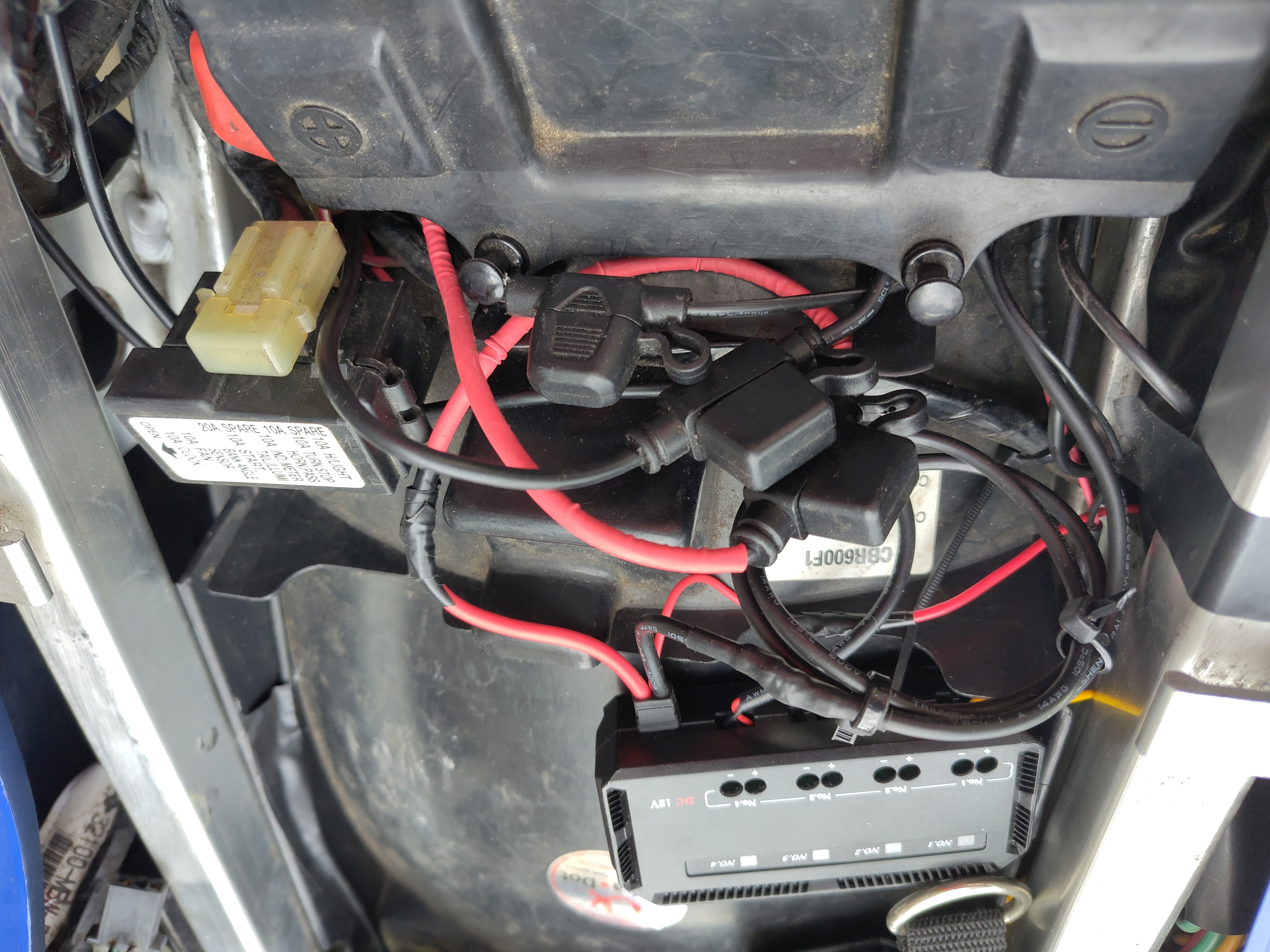
You might be able to see in the picture there are three inline fuse
holders. Yes, I actually have more things that need an always-on power
connection (dashcam, optimate, and the accessory fuse box itself) than
I have accessories.
Someone should make a secondary fuse box that has both switched and
unswitched connections.
[*] my bike is old enough to actually have a switch to turn the
headlight off. I pretty much never use it, though, unless it's been
standing for a long time and I'm worried it won't start with the added
power drain from the headlights.
Matching Green#
Sun 03 Aug 2025 06:58:47 PM UTC
I've ridden this route three times. The first time I started out
following a Kurviger round trip route and then I was having so much
fun on the B184 that I refused to take the left turn that Kurviger
wanted me to take[*], and instead I followed signposts for a
while. When I got home I spent some time with a map and an open tab on
Google Streetview and figured I had approximately ridden Abridge -
Stanford Rivers - Chipping Ongar - Fyfield - some Rodings - Hatfield
Heath - Matching Green - ("Watery Lane, narrow road with gravel in the
middle) - Moreton - Bovinger - Tyler's Green - North Weald - Epping
and then home, and and almost all of it - all the bits that weren't
Epping rush rour - I would have gladly ridden again. A lot looked
vaguely familiar (although backwards) from riding the Dun Run, albeit
it didn't look that similar because daylight.
After the second time around - a bit faster, because I had no wrong
turns or need of pulling over to look at the map - I looked at the
Hundred Parishes website and found I'd passed through at least one of
the place on their list, so I decided to ride the whole thing a third
time and inaugurate the 100-parishes topic.
 This is the green in Matching Green. It has
- lots of grass
- trees
- a pond: very little water currently, no ducks that I saw (I may have missed them)
- a cricket pitch and pavilion
The green is overlooked by thatched cottages and a pub. There are traditional stripey signposts in the area


Photos are of the cricket pavilion, if that's the right word, and the weathervane on the roof, depicting a man with a scythe and what appears to be (but probably isn't) a walking frame.

 My motorcycle is not thematically appropriate to the "green and rural" theme in this thread but I am going to include this photo anyway (1) to show I was there and didn't lift the pictures from the internet; (2) because it is IMO a very pretty motorbike.
[*] https://tueb.telent.net/w/jiq1UZs4mc38mSeuB9N1wS this is what Kurviger wanted to save me from.
Respinning threads from Gotosocial#
Mon 25 Aug 2025 04:46:35 PM UTC
I made a small Fennel script to extract the text from a GoToSocial thread and
splat it into a text file. I have used it once and
it seemed to work, so I'm going to explain it a bit.
It needs lua-http,
rxi's json.lua, and
net-url aka net.url aka neturl,
all of which you can
currently get from MS Github, if they haven't already replaced the whole site
with an AI-mediated barrel of slop by the time you read this.
(local request (require :http.request))
(local url (require :net.url))
(local json (require :json))
(local {: view } (require :fennel))
lua-http might be a bit overkill here but I've used before and I went
with what I know. I wrapped it here with a little send-request function
so I didn't have underscores all over the place.
The last time I really dug into HTTP was about 2003, so this HTTP/2
concept that the request method is actually a header field with a
colon in front of its name is ... unusual and new to me.
The url passed into this method comes from net-url and is actually a
table with a metatable that defines __tostring. This is like a
string when you print it, but not quite enough like a string when you
pass it to lua-http, hence the cast.
(fn send-request [url method headers body]
  (let [r (request.new_from_uri (tostring url))
        h r.headers]
    (h:upsert ":method" method)
    (when body
      (r:set_body body))
    (each [k v (pairs headers)]
      (h:append k v))
    (let [(headers stream) (r:go)]
      (stream:get_body_as_string))))

(fn json-request [url method headers attrs]
  (let [body (json.encode attrs)]
    (-> (send-request url method headers body)
        json.decode)))
The next bit is
pretty much a straight translation of
the Gotosocial API login flow documentation from
bash + curl into Fennel.
One surprise here was that the net-url API is very side-effecty. If you write
(let [u (url.parse "HTTPS://example.com")]
  (print (/ u "some" "path" "segments")))
It will print https://example.com/some/path/segments, as you
might expect from skimming the docs, but it will also change the value
of u, as you might not expect unless you'd actually read the docs
(guess who didn't and only skimmed them). u:resolve is a more
functional alternative.
(fn oauth-new-client [root-url client-name]
  (json-request
   (.. (root-url:resolve "/api/v1/apps"))
   :POST
   { :content-type "application/json" }
   {
    "client_name" "fetch-thread"
    "redirect_uris" "urn:ietf:wg:oauth:2.0:oob"
    "scopes" "read"
    }))

(fn oauth-access-token [root-url client_id client_secret code]
  (let [body {
	      : client_id
	      : client_secret
	      :redirect_uri "urn:ietf:wg:oauth:2.0:oob"
	      : code
	      :grant_type "authorization_code"
              }]
    (json-request
      (.. (root-url:resolve "/oauth/token"))
      :POST
      { :content-type "application/json" }
      body)))

(fn request-api-token [root-url]
  (let [{: client_id : client_secret } (oauth-new-client root-url "unroll.fnl")
        redirect-url (..
                      root-url
                      "/oauth/authorize?client_id=" client_id
                      "&redirect_uri=urn:ietf:wg:oauth:2.0:oob&response_type=code&scope=read")]
    (io.stdout:write "login to the instance and then paste in the token here\n> ")

    ;; hardcoded firefox because `xdg-open` doesn't work for
    ;; me right now. That's something to fix another day.
    (os.execute (string.format "firefox %q" redirect-url))
    (let [code (io.stdin:read)
          {: access_token}
          (oauth-access-token root-url client_id client_secret code)]
      access_token)))
The net result of all that code will return an access token.
The access token can
be used with the other API calls
but not, as I originally thought it would, for fetching actual statuses
like /users/dan/statuses/01K2Q3MHSGMHB2CFTRCE6FBP5T.
That needs HTTP signatures (a.k.a "authorized fetch") which is something quite else and looks more involved than I wanted to get into at 12:30am.
However, we can fetch the status content in a different format using an API endpoint:
/api/v1/statuses/01K2Q3MHSGMHB2CFTRCE6FBP5T gets the post itself and ..../context gets its ancestor and descendant statuses.
(fn fetch-post [root-url headers id]
  (let [url (root-url:resolve (.. "/api/v1/statuses/" id))]
    (json-request url :GET headers nil)))

(fn fetch-post-context [root-url headers id]
  (let [url (root-url:resolve (.. "/api/v1/statuses/" id "/context"))]
    (json-request url :GET headers nil)))
Our conversion to markdown is extremely rudimentary:
(fn format-post [post]
(each [_ img (ipairs post.media_attachments)]
(print (string.format "" img.description img.url)))
(print post.text))
and the rest is just calling things in order.
- To avoid having to interactively login every time we run the script,
we write the access token to a file
- my blog software goes wonky if posts don't have titles, so make one up
- the script is called with a status URL, so we extract the id for the status by assuming it's the last part of the url path
(fn extract-title [text]
  (->
   (or (string.match text "(.-)[%.%?%!\n]") text)
   (string.sub 1 60)))

(fn root-and-id [url-str]
  (let [u (url.parse url-str)]
    (values
     (u:resolve "/")
     (string.match u.path ".+/(.-)$")
     )))

(let [dotfile (string.format "%s/.rethread" (os.getenv "HOME"))
      (root-url post-id) (root-and-id (. arg 1))
      f (io.open dotfile :r)
      api-token
      (if f
          (f:read)
          (let [t (request-api-token root-url)]
            (with-open [out (io.open dotfile :w)]
              (out:write t)
              t)))
      headers { :authorization (.. "Bearer " api-token)}
      context  (fetch-post-context root-url headers post-id)
      post (fetch-post root-url headers post-id)
      first-post (or (. context.ancestors 1) post)]
  (print (.. "Title: " (extract-title first-post.text)))
  (print (.. "Slug: " post.id))
  (print (.. "Date: " (. first-post  :created_at)))
  (print "\n")
  (each [_ p (ipairs context.ancestors)]
    (format-post p))
  (format-post post)
  (each [_ p (ipairs context.descendants)]
    (format-post p)))
Aftercare
Some thoughts as they occur to me:
-
I said in 2020 that I no longer have a
favourite programming language, but maybe five years later I do
again and it's Fennel? It would be nice if I could have LuaJIT and
Lua 5.4 at the same time but ... there's always something we can't have
-
It's quite hacky: there is no error checking. If it doesn't work,
add printf debugging.
-
It's quite hacky: it has no tests. I usually prefer to code test-first, but this
isn't. That's because it's 90% made of API client glue and 10% trivial,
which is the kind of scenario where I've never had value from
test harness infra that I couldn't get by running it.
-
It's quite hacky: we don't check if the access token has expired. If the
access token expires, delete ~/.rethread and run the script again.
-
Writing this blog entry has provided an opportunity to learn that
the bare url markup in Cripslock is buggy, so yay for finding that
out, I guess.
-
I would use lua-http and rxi/json again, but net-url is not (yet?)
the perfect beautiful gem of programming I could wish for. I'd like
something a bit closer to (dare I say it) Ruby, for example, where
the URL objects are value objects instead of being mutated in place.
All of that is a very long-winded way of saying "expect to see more
blog posts that are really just recycled fediverse threads", but I'm
now on my fourth fediverse server and I won't put up again with saying
goodbye to all my posts every time I change to a new instance. So,
I am blogging for persistence (and some day, less shitty search).